Science Curriculum Statement
At Fairfield Primary School, our vision is that science provides the foundations for exploring, discovering, and understanding the world around us through the distinct disciplines of biology, chemistry, and physics. We nurture children’s natural curiosity through a rich, stimulating curriculum designed to inspire a lifelong love of learning. In every science lesson, pupils do not just learn about science—they learn how to think and work as scientists. Each lesson is explicitly anchored around one of our seven core Working Scientifically skills:
Asking questions, Making predictions, Setting up tests, Observing and measuring, Recording data, Interpreting and communicating results, Evaluating.
These seven skills act as the engine for learning across all year groups. By using them as our focal points, children actively master key scientific concepts through authentic hands-on enquiry. Through carefully planned educational visits, whole school enrichment events, and outdoor learning, we forge meaningful links between classroom learning and real-life applications—both within our local community and across the wider world. By prioritizing curiosity, critical thinking, and independence, we empower our children to become confident, creative learners. As they leave Fairfield, our pupils are equipped with the foundational knowledge and scientific enquiry skills required to understand the uses, implications, and exciting possibilities of science today and in the future.
Key Documents
Our Seven Core Working Scientifically Skills
At Fairfield, we believe that true scientific understanding goes beyond memorizing facts—it requires learning how to think, investigate, and reason like a scientist. Rather than saving scientific skills strictly for practical investigations, one of our seven core skills serves as the active anchor for every science lesson. By making these skills an integral part of each lesson, pupils consistently engage through active enquiry and reflection. The skills (outlined in further detail below) are visible on all Science Working Walls and form part of the children's recording in books.
Science Skills Objectives
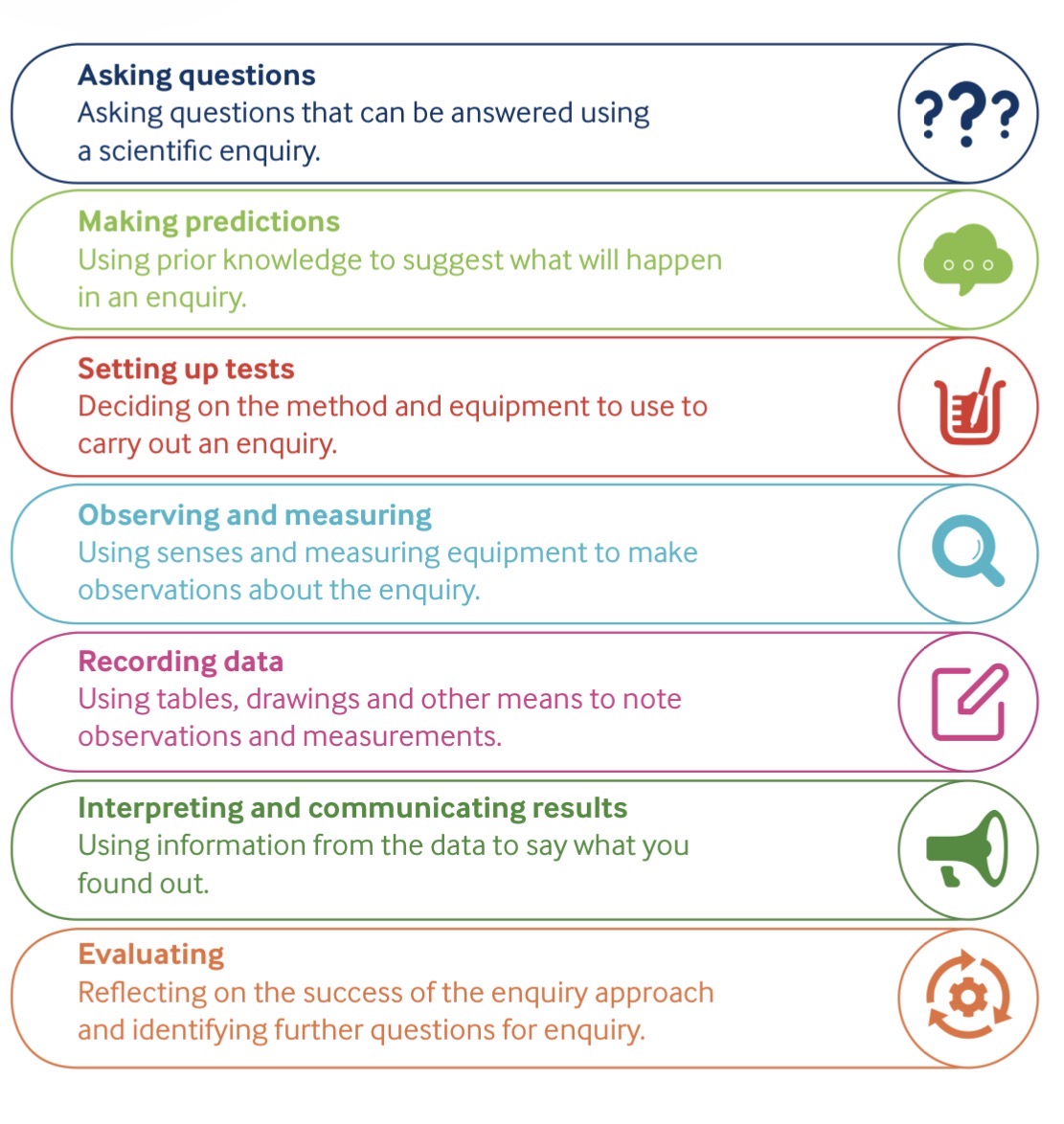
In practice, a skill objective might focus on taking precise measurements during a hands-on investigation, or it might frame a key question we ask ourselves, to guide the lesson. As pupils progress from Early Years through to Year 6, these seven objectives build incrementally in depth and complexity across biology, chemistry, and physics. This approach ensures that practical enquiry and conceptual knowledge develop hand-in-hand, empowering every child to become a confident, analytical, and independent scientist.
Science in Action
The galleries below show out pupils, from Nursery to Year 6 exploring and discovering the world around them through the disciplines of biology, chemistry and physics within our Science Curriculum.
Biology
Chemistry
Physics
Practical Investigations
Our Science Curriculum allows opportunities for pupils to explore, discover, hypothesise and test ideas. Our practical learning experience is central to developing our children's’ working scientifically skills (listed above); it also engages them and communicates the wonder and excitement of science. It is only by doing practical investigations themselves that children develop a more scientific understanding of the world around them and begin to understand the nature of science. We recognise that practical investigation is important, because it:
- Develops pupils’ science skills
- Develops their understanding of the nature of science
- Supports their learning and understanding of scientific concepts
- Motivates children and develops their curiosity about the world.
The photographs below show pupils enjoying practical exploration in topics including: The Human Body, Light and Shadows, Plants and Germination, Ecosystems, Digestion and even some fantastic CREST activities:
British Science Week
At Fairfield Primary School, we are proud to engage in the annual British Science Week, celebrating the wonder, relevance and excitement of science with our whole school community. British Science Week provides an opportunity for pupils to step beyond the everyday science curriculum and immerse themselves in inspiring investigations, challenges, experiments and real-world scientific experiences. It encourages children to ask questions, think creatively, solve problems and see themselves as scientists, while developing a deeper understanding of how science shapes our lives and the world around us. Through whole-school activities and shared experiences, British Science Week also promotes collaboration and allows children of all ages to learn from and inspire one another. Most importantly, it helps us to nurture our pupils’ natural curiosity and build a lasting enthusiasm for science, reinforcing our belief that every child can be a confident, capable and curious scientist.